Using air guns to effectively combat drones.
Using air guns to effectively combat drones.
The modern war in Ukraine and Iran has shown that conventional weapons systems – tanks and armored vehicles, which dominated the battlefield for over 100 years – have lost their relevance and are being withdrawn from the battlefield.
Flying drones, which are inexpensive and capable of destroying a tank or any other military or infrastructure facility, are becoming increasingly important.
Therefore, protecting military and civilian facilities from unmanned aerial vehicles (or drones) is a pressing issue today. Electronic warfare (EW) systems, machine guns, small-caliber automatic cannons, anti-aircraft missiles, helicopters, aircraft, and, of course, the drones themselves are used for this purpose.
However, all these systems are not very effective and their use is expensive. A missile or a volley of projectiles from an automatic cannon can sometimes cost several times more than an attack drone.
For several years, our company has been developing several types of pneumatic automatic artillery systems capable of destroying drones, certain types of missiles, and helicopters. These artillery systems have two or four barrels that fire salvos from their barrels, creating a cloud of shrapnel near passing drones. This cloud can be up to 200 meters across, more than enough to destroy any drone.
When fired, these systems produce a quiet sound and have a recoil impulse 5-10 times lower than their powder-based counterparts. With an 80-millimeter caliber, they can fire over 20 salvos per minute from all barrels, which equates to 40 to 80 shots per minute.
The service life of such a system can exceed 100,000 shots per barrel, which, given the possibility of using very inexpensive projectiles made of composite materials, eliminates the problem of the cost of consumable ammunition.
Such systems would also be very effective against tactical ground targets, but in this proposal we are considering them only as anti-drone systems.
The proposed systems can be manufactured in calibers from 50 to 90 millimeters, but in this proposal we will focus on one caliber – 80 millimeters.
In this proposal, we present basic versions of the systems, each with manual, albeit highly effective, fire control and targeting. However, in the near future, several levels of modernization are possible for these systems, including increasing their firing power, doubling their maximum range, and equipping them with automatic targeting mechanisms. The modernization also includes improving the efficiency of the compressed air supply mechanisms for firing.
Other upgrades to this system are possible, but this project is laying the foundation for them. While such a system could ultimately boast impressive performance, the 80mm system is a basic option that can be upgraded in multiple stages, with each subsequent level enhancing its performance.
Below, in the table, are brief technical characteristics of two such systems with two and four barrels, respectively, and in their basic version.
No. | Characteristic | Units of measurement | Two barrels | Four barrels |
1. | Caliber | mm. | 80 | 80 |
2. | Number of trunks | pcs. | 2 | 4 |
3. | Number and capacity of stores | pcs. | 2x25 | 4x5 |
4. | Rate of fire | pcs/min | 40 | 80 |
5. | Maximum firing range | m. | 6000 | 6000 |
6. | Maximum firing height | m. | 3000 | 3000 |
7. | Magazine reload time | sec. | 20 | 6 |
8. | System resource, total | shots | 200,000 | 400,000 |
Below, in the figure, a variant of the external appearance of a self-propelled automated anti-drone system with two barrels is proposed.

Compared to similar projects worldwide, the proposed project has a cost tens of times lower and a completion time several times shorter. In terms of cost-time-results-prospect ratio, the proposed project is tens of times superior to similar projects worldwide. This type of work is possible because the project team is not working for a salary, where people are motivated by long-term commitment, but rather for the end result, where the team is motivated by the speedy completion of the work with the highest possible quality.
HISTORICAL BACKGROUND
The history of pneumatic artillery begins in the second half of the 19th century, when powerful pneumatic guns up to 381 mm in caliber were developed in the United States for the Coast Guard and for installation on heavy ironclads and even submarines in place of torpedo tubes. These guns were designed to fire projectiles of immense destructive power (dynamite shells), which were impossible to fire from conventional gunpowder cannons because the dynamite exploded in the barrel.


During World War I, pneumatic mortars were produced in England and France that could launch projectiles weighing up to 35 kg over a distance of over a kilometer. Incidentally, these were the first mortars in the world.
Later, gunpowder artillery evolved with the development of new propellants, explosives, and other technologies, and the need for pneumatic artillery disappeared, especially since pneumatic artillery remained technologically at the level of its earliest systems. Only our company was able to develop technologies capable of taking pneumatic artillery to a new level, as confirmed by both theoretical developments and practical testing of the experimental system.
Airguns for counter-drone combat. Part two.
In our previous
article, we described our company's development of pneumatic guns for various
purposes, specifically their potential use as anti-aircraft systems, or more
specifically, systems designed to combat various types of drones.
Pneumatic guns
themselves are artillery systems that, in many respects, surpass their
powder-based counterparts. The core technologies for these guns were developed
by our company, have been tested, and have demonstrated excellent results. But
what makes them so attractive for use against drones?
Currently, the
main problem is Iranian Shahed drones and Russian Geranium drones. There are
many of them, they fly in large groups, and they are quite difficult and
expensive to shoot down, although various systems exist for this purpose, from
machine guns to Patriot-type anti-aircraft missiles.
However, all
these existing systems are not very well suited to shooting down Shahed-type
drones.
1) The machine
gun mounted on the combat vehicle's turret produces an excessively wide bullet
spread, often resulting in an attacking drone easily flying through the swarm
of these bullets without being hit. Even direct hits don't always destroy the
drone—a bullet can make a small hole in the drone's wing without causing any
damage.
You can increase
the density of fire from machine guns by doubling or quadrupling them, but even
then we end up with a high consumption of ammunition and overheating of the
machine gun barrels from prolonged use, and this is without a guarantee of
shooting down the drone.
2) Automatic
small-caliber cannons like the German Gepard have the same drawbacks as machine
guns, but their ammunition consumption is significantly more expensive.
Furthermore, production capacity for shells for such systems is currently quite
limited worldwide.
There are other
problems associated with the use of machine guns and small-caliber
anti-aircraft guns against drones.
3) Anti-aircraft
missiles like the Israeli Iron Dome and the American Patriot missiles have
proven extremely ineffective against drones. The Iron Dome proved to be a leaky
umbrella. This is understandable. The Shahed missiles fly at low altitudes,
where the effectiveness of anti-aircraft missiles is quite low. Sixteen Iron
Dome missiles can only shoot down a few drones, and then a single drone will
destroy the missile launcher itself. Furthermore, shooting down a $20,000 drone
with a missile five times more expensive isn't the most cost-effective
proposition. Not to mention Patriot missiles, which cost several million
dollars. And the anti-aircraft systems themselves, costing hundreds of millions
of dollars, are attractive targets for drones.
4) And finally,
the newest addition of the season: drone fighters. This is a cheap way to
combat attacking Shahids, but their actual effectiveness is very low, and
according to the operators of these drone fighters themselves, in practice it
amounts to no more than 10%.
Compared to all
the described options for combating drones, a pneumatic anti-aircraft gun will
be a much more effective means of destroying drones.
As described in
the previous article, such a four-barrel cannon, with a caliber of 70-90
millimeters, with a single salvo from all barrels is capable of creating a
destructive cloud up to 200 meters in diameter in the path of a drone and
destroying any drone in the area of this cloud.
And if the
system misses, which is highly unlikely, it can immediately fire another salvo,
and so on. The cost of such a salvo of four projectiles would be around $600,
and the composite projectiles themselves can be produced in the millions per
month. With a system lifespan of 100,000 rounds per barrel, it can be used to
fire at anything moving within its range without concern for cost.
Moreover, the
production cost of such anti-aircraft systems, depending on their
effectiveness, will range from 500 thousand to 2 million dollars, which is also
not a burden on the budgets of Middle Eastern countries.
And please note:
The figures cited in this article are current. They will continue to rise, and
very sharply. This is especially true if the Far East region—Taiwan and its
surroundings—also flares up.
Yes, the
prospects for mass-producing pneumatic anti-aircraft guns to the theater of war
seem somewhat remote – at least three years. The design, purpose, and conditions
need to be agreed upon. Mass production of the guns and their shells needs to
be organized. But who prevented the Persian Gulf countries from joining this
project 5-6 or 8 years ago? After all, they knew about this project, especially
the United Arab Emirates, but they thought war wouldn't come to them. And why
should they? After all, they sit quietly, trade oil and gas, and don't bother
anyone.
But war has
finally come. This isn't the last war in the Middle East, and future wars will
only see increased use of drones. And there's no adequate defense against them.
Meanwhile, the cost of just two destroyed high-rise buildings in Dubai, spent
on the proposed project, could have effectively protected the entire country
from the drone threat. And there wouldn't be any destruction, fires, or deaths
now.
Investing in
gold toilets, bathtubs, and toilet handles is a good investment, but it doesn't
guarantee safety. You can't hide from the Shahed in a toilet, even one made of
pure gold.
However, the
anti-aircraft systems we propose are not a panacea for all ills either. They
are designed to shoot down most types of drones, but they are almost useless
against high-altitude drones, hypersonic missiles, and ballistic missiles. They
simply plug a gap in modern defenses. And nothing more.
At the same
time, it's already possible to create systems capable of stopping any war with
any aggressor. Most Middle Eastern governments are aware of this, but this work
requires significant financial investment, and golden toilets are still a
distant memory. With such approaches, Middle Eastern or Gulf countries will
have to endure more than one war on their soil. But that's another topic.
Thank you for
your attention.
Dear ladies and gentlemen!
We see that the information we provided about new methods of combating drones has generated great interest, especially in the Middle East and the Persian Gulf.
It's clear that before the US-Israeli war unleashed against Iran and Iran's retaliatory missile and drone strikes against Israel and all its neighbors hosting US military bases, no one imagined the problem of drone defense would become so acute. All the Gulf countries believed that if they pumped oil, the Americans would shield them from all possible problems. But it turned out that the American umbrella is very leaky and can't even cover its main ally, Israel. Now, every country must find ways to defend itself from such attacks. And judging by how events are unfolding in the region, this problem will drag on for years, even if the war itself ends. There will be terrorist attacks, like the one between Israel and Gaza, and they too will need to be defended against. Wars could also break out between other countries in the region (and beyond).
But these strikes also revealed another problem: the fires they cause, especially in high-rise buildings.
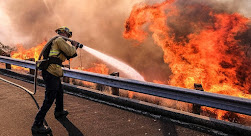
Today, there are no (or almost no) effective fire suppression systems in the world for extinguishing fires above 60 meters or at a safe distance from the fire source. This is clearly demonstrated by fires in high-rise buildings, such as those in Dubai. Incidentally, such buildings have burned many times, even without war. Interestingly, such buildings are equipped with their own fire suppression systems, but in a major fire, this system is the first to fail. This often results in many casualties. There's another reason for this: the architecture of the buildings themselves. For example, if, God forbid, the Burj Al Khalifa were to catch fire, no one above the fire zone would be able to escape. This is due to the tower's stepped design. Anyone attempting to use a personal rescue kit on the outside of the building would be incinerated on the first step. And there's nothing to extinguish such a building from the ground, and helicopters won't be able to do so either. What looks beautiful is never practical, much less safe.
Why do we pay so much attention to this problem?
The fact is, our company develops new technologies in various fields—combat systems, counter-drone systems, alternative energy, firefighting systems, and other interesting areas. But our technologies could also effectively address the problem of extinguishing high-altitude fires described above, as well as the problem of combating drones.
To extinguish fires at low altitudes—up to 120 meters (twice as high as those available in your countries)—we are developing pulse-action hydropneumatic fire extinguishing systems, which are far more effective than conventional hydraulic jet cannons. And for extinguishing fires at altitudes of up to 1,000 meters or more, our company is developing automatic pneumatic cannons (similar to anti-drone systems) that can extinguish any fire by delivering a special extinguishing agent to the source.
The proposed fire extinguishing systems were developed to extinguish large-scale forest and man-made fires at a great distance, safe for the fire crews themselves. One such heavy fire-extinguishing system is capable of extinguishing even a very strong fire in 15 minutes over an area of up to 5 hectares and from a distance of up to 2-3 kilometers.

Presentation of the project in China.
Technically, these firefighting systems are the most efficient in the world. Moreover, their production is extremely cost-effective. As for demand, procurement volumes are currently being discussed in just one European country, enough to keep production busy for 10 years.
And here's the interesting thing: The Persian Gulf countries have known about our company's developments for over six years, but none of their governments have offered us honest cooperation. Perhaps your governments don't care about their citizens or visiting workers?
Thank you for your attention.
Best regards, Oleksandr Kostrytskyi, CEO "ION" Energy-saving technologies LTD
My WhatsApp +380675066940

Комментарии
Отправить комментарий